Marketing Best Practices
AI Visibility: The Complete Guide for Commercial Real Estate
Last updated
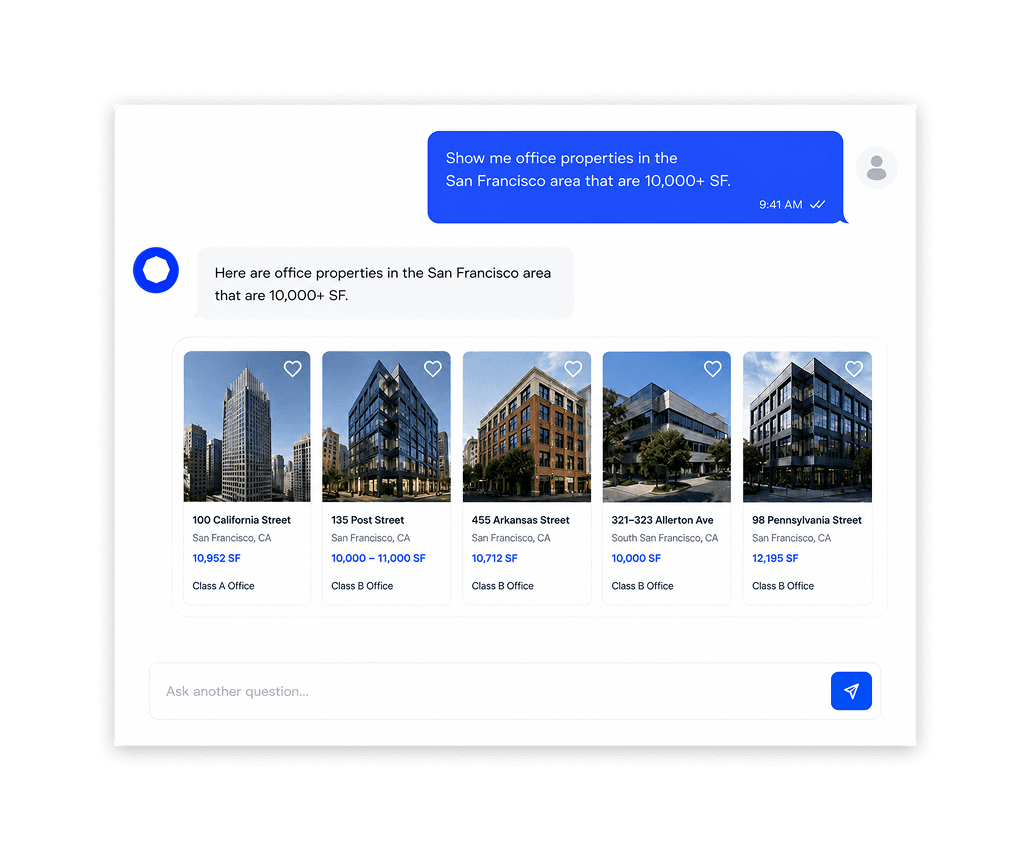
Prospects are searching for CRE brokers and deals differently now. Instead of Google, many are using:
- ChatGPT
- Perplexity
- Claude
- Google AI Overview
These systems work differently than search engines. They pull information from different sources and rank it using different rules.
Most CRE firms aren’t set up for AI search.
The firms that are getting visibility in AI systems are winning deals. The ones that aren’t are being overlooked.
This guide explains everything your CRE firm needs to be doing to be found by AI systems.
The AI Visibility Problem
We tested a theory. We asked ChatGPT to find the best commercial real estate brokers across 20 major U.S. markets.
The results:
- Some markets produced defensible answers (but most didn’t)
- Large national firm brokers got recommended consistently
- AI provided answers that looked right, but couldn’t verify it had identified the right brokers
Why? It wasn’t about the quality of the brokers. It was about the information available about them online.
What worked: When we went deeper and asked for specific information (deal counts, recent activity, specific asset classes), AI recommendations improved significantly. The more concrete the data, the better the answers.
What didn’t work: Generic statements like “best broker in Miami” or “expert in commercial real estate” gave AI nothing to work with. It couldn’t rank brokers on credentials or reputation alone.
The core insight: AI systems recommend based on searchable evidence, not merit. A broker’s track record only matters if it’s documented, structured, and current online.
The reality for most CRE firms:
- Broker profiles are outdated or incomplete
- Deal records are scattered or missing key details
- Information is inconsistent across website, LinkedIn, and directories
- No structured data that AI systems can easily read and understand
- Historical information is mixed with current activity, confusing AI about what’s active now
From an AI system’s perspective, most CRE firms are invisible or misrepresented.
This is the visibility gap. And it’s costing you deals.
What AI Systems Actually Look For
AI systems rank information based on four factors. Missing any of these makes you invisible or misranked.
1. Specificity
Generic statements don’t work for AI. AI can’t understand vague claims because it has nothing concrete to verify or pass along to users.
What doesn’t work:
- “Experienced broker”
- “Market leader”
- “Expert in multifamily”
- “Proven track record”
These could mean anything. AI has no way to verify them or explain them to a user searching for brokers.
What works:
- “Closed 12 multifamily deals in Dallas, 2024-2025”
- “Specializes in Class A office in Manhattan with $2B+ in career transactions”
- “Lead broker on 47 industrial transactions averaging $15M per deal”
- “Recent deals: 250K SF warehouse, Dallas; 80-unit apartment complex, Austin”
AI can verify these claims, compare them across brokers, and explain them to users. Specificity makes you rankable.
2. Freshness
Current information beats old information. Period.
The problem: Website lists deals from 2022 as “recent activity.” AI interprets this as: your firm hasn’t done deals recently. You’re inactive. You’re not worth recommending to someone looking for a broker who’s actively in the market now.
The consequence: AI ranks you below firms that show recent activity, regardless of your actual deal flow.
The solution: Keep your most recent transactions visible. Archive older deals (don’t delete them, but move them to a separate section). Update broker profiles with current activity at least monthly.
Current activity signals that your firm is still in the market and worth calling.
3. Clear Connections
AI needs to understand how things link together. Specifically, it needs to know:
- Which broker closed which deal
- What asset class was involved
- What market/location
- When it closed
- Deal size and details
Why it matters: When someone asks ChatGPT, “Find me a broker who does multifamily deals in Dallas,” the AI needs to find a page that clearly shows a broker did multifamily deals in Dallas. If that information is scattered across five different pages, or if a deal page doesn’t clearly name the broker, AI can’t make the connection.
The structure problem: If your deal pages don’t link to brokers, or if broker profiles don’t link to deals, or if deals aren’t tagged by asset class and location, you’re making it impossible for AI to understand your expertise.
AI systems need structured connections to rank you effectively.
4. Consistency
Information should be the same across all platforms. Contradictions confuse AI and reduce your ranking.
Real inconsistency examples:
- Broker’s LinkedIn says “office specialist” but your website says “retail focus”
- Deal listed as Dallas on your site but Houston on a commercial real estate directory
- Different credentials or specialties listed in different places
- Company name spelled differently on different platforms
Why it matters: When AI sees conflicting information, it becomes uncertain. Uncertainty = lower ranking. If one source says your broker does office and another says retail, AI doesn’t know which is true. It downranks you because you’re unreliable.
Consistent information across your website, LinkedIn, directories, and any other platforms = AI confidence. Conflicting information = AI confusion and lower rankings.
Bottom line: AI needs specific, current, clearly structured, and consistent information. It needs to understand how your brokers, deals, and markets connect. Most CRE firms don’t have this organized, which is why they’re often invisible to AI.
3 AI Optimization Fixes
You need to fix three things to be visible to AI.
Fix 1: Broker Profiles and Transaction Records
This is the foundation. Every broker needs a complete, specific profile.
What each broker profile needs:
- Current specialties (be specific: “Class A office in Midtown Manhattan” not just “office”)
- Verifiable credentials (licenses, certifications, awards)
- Recent transaction history (deals closed in the last 12-24 months, listed first)
- Direct links to individual deals they’ve closed
What each deal page needs:
- Broker names who closed the deal (link to broker profiles)
- Deal size/value
- Asset class (multifamily, office, industrial, retail, land, mixed-use, etc.)
- Market/location (city, neighborhood, zip code)
- Closing date
- Deal summary with key details
Why it matters: AI learns what your brokers specialize in by analyzing what they’ve actually done. If a broker has closed 15 multifamily deals in Dallas, AI will recommend them for multifamily in Dallas. This is evidence-based ranking. It works better than any bio or credential because it’s verifiable and specific.
Fix 2: Market and Asset Class Content
Create landing pages or sections for each market and asset class your firm is active in.
What to include:
- Recent deal activity in that market/class (show your firm’s latest transactions)
- Market trends and insights
- Your firm’s track record in that market/class
- Links to brokers who specialize in that market/class
Real example: A “Multifamily in Dallas” page that shows your last 10 multifamily deals in Dallas, links to the brokers who worked on them, and provides market context. When someone asks ChatGPT, “Who are the top multifamily brokers in Dallas?” or “What’s happening in the Dallas multifamily market?” your page becomes a source AI can reference.
Why it matters: Shows AI that you have deep knowledge and active work in specific markets. It positions your firm as a category expert, not a generalist. AI prioritizes specialists.
Fix 3: Consistency and Accuracy
Information must be the same across all platforms.
Where information lives:
- Your website
- LinkedIn company page and broker profiles
- Industry directories and broker networks
- Google Business listing
- Any partner or affiliate listings
What to standardize:
- Broker specialties and descriptions (word-for-word the same)
- Deal details if listed in multiple places
- Credentials and awards
- Company description and focus areas
- Contact information and locations
The process:
- Create a master list of broker specialties and descriptions
- Update everything to match
- Set up a monthly audit to catch inconsistencies
- When a deal closes, update it on all platforms simultaneously
Why it matters: When AI finds the same information about your broker or firm across multiple authoritative sources, it treats that information as verified and trustworthy. It ranks you higher. When information conflicts, AI is uncertain and ranks you lower. Consistency = credibility.
How to Get Started
Option 1: Build It Yourself
This is the DIY approach. It takes work, but it’s straightforward and free beyond labor.
Step 1: Complete Audit Spend time documenting the gaps.
- What broker information exists online about your firm?
- What’s missing (specialties, credentials, recent deals)?
- What’s outdated (deals from 2022 still showing as recent)?
- What’s inconsistent across your website, LinkedIn, and directories?
This audit is critical. You can’t fix what you don’t know about.
Step 2: Map Your Data Create a master data structure for how you want everything organized.
- List every broker with their specialties, credentials, and recent transactions
- List every deal you want to highlight (focus on recent, significant deals first)
- Create categories for each market and asset class you work in
- Document where each piece of information currently exists and where it should go
Step 3: Build Broker Profiles Create or update complete profiles for every broker on your website. Link each one to the deals they’ve closed.
Step 4: Build Deal Pages Create individual pages for each significant deal. Include broker names, asset class, location, deal size, and closing date. Link these pages back to broker profiles.
Step 5: Create Market and Asset Class Pages For each market and asset class you focus on, create a landing page that summarizes your activity and lists your recent deals in that category.
Step 6: Audit for Consistency Go through your website, LinkedIn, directories, and any other places your information appears. Make sure everything matches.
Step 7: Update Ongoing New deal closes? Update it on all platforms. Broker changes specialties? Update all references. This needs to be part of your regular process.
The AI Visibility Checklist walks you through all of this step by step. It’s your playbook.
Option 2: Automate It
Doing this manually takes months and constant maintenance.
Using the SharpLaunch WordPress plug-in automates the AI optimization framework:
- Automatic page generation: Creates SEO-optimized, AI-ready pages for every listing on your domain
- Structured data handling: Builds in the data structure AI systems need (no manual coding)
- Real-time sync: Keeps listings current without manual updates
- Broker integration: Links brokers to deals automatically
The result: Your listings get discovered in ChatGPT, Perplexity, and other AI search tools. Your brokers become visible to prospects searching through AI.
Learn how the SharpLaunch PSE supports AI visibility
The difference: Instead of your team spending weeks mapping data and building pages, they spend a few hours setting up the sync. Everything else is automated.
Real impact: Listings start appearing in ChatGPT, Perplexity, and Google AI within weeks instead of months.

What to Do Now
Stop treating AI visibility as something to think about later. It’s a competitive lever right now.
This week:
- Get the AI Visibility Checklist
- Spend 10 minutes filling it out (honest assessment of where you stand)
- Identify your top 3 gaps
Next 30 days:
- Fix your biggest gap first (usually it’s broker profiles)
- Then deal pages
- Then market/asset class content
Pick a path:
- DIY path: Use the checklist as your guide and work through it systematically
- Automation path: Set up SharpLaunch and let it handle the heavy lifting
Either path works. The only path that doesn’t work is waiting.
Your competitors aren’t waiting. Prospects are searching via AI now. Every week you delay is a week your firm isn’t showing up in those searches.

Related Blog Posts
Marketing Best Practices
10 Reasons Why You Need a Property Management Website
As the global pandemic continues to drive astonishing advances in digital life, the commercial...
Marketing Best Practices
10 Reasons Why You Need a Strong Digital Presence in Commercial Real Estate
As a CRE professional, you want to make a good first impression with any potential...
Marketing Best Practices
11 Common Commercial Real Estate Marketing Mistakes to Avoid at All Costs
Marketing mistakes in commercial real estate can cost you leads and lost revenue...