
Marketing Best Practices
How to Create an Offering Memorandum that Wins Over Investors
Table Of Contents
Share post


In the fast-paced world of commercial real estate investment sales, an Offering Memorandum (OM) serves as a powerful tool to attract serious investors, instill confidence in the opportunity, and ultimately facilitate successful transactions.
This guide explains what an offering memorandum is, what every section must include, and how to create one that attracts qualified buyers and accelerates your deal timeline.
What Is an Offering Memorandum?
An offering memorandum (OM), sometimes called a confidential information memorandum (CIM) or deal book, is a formal marketing document prepared by a broker or seller to present a commercial real estate asset to prospective buyers. It packages everything a serious investor needs to evaluate the opportunity: property details, financial performance, market context, and deal terms.
Unlike a one-page flyer, an OM is designed for qualified investors who have signed a non-disclosure agreement (NDA) and are actively considering a purchase. It is longer, more detailed, and more analytical. A well-executed OM signals that the broker and seller are serious, organized, and professional…. qualities that directly influence buyer confidence and the competitiveness of offers received.
A flyer is public-facing and used to generate initial interest. An OM is confidential, distributed only to qualified prospects who have signed an NDA, and contains detailed financial and operational information a flyer would never include.

What Does a Commercial Real Estate Offering Memorandum Include?
A complete OM typically runs 20 to 60 pages depending on the complexity of the asset. While there is no universal format, the following sections are standard across office, retail, industrial, and multifamily deals. Omitting any of these raises red flags for sophisticated buyers.
1. Executive Summary
The first section a buyer reads. It must answer the key questions in two pages or fewer: What is the asset? Where is it? What is the asking price? What is the investment thesis? Think of it as the pitch if the executive summary does not compel the reader to continue, the rest of the document does not matter.
- Property name, address, and asset type
- Asking price or guidance range
- Cap rate and key financial metrics
- A one-paragraph investment rationale explaining why this deal makes sense now
2. Property Description
A factual account of the physical asset. This section establishes credibility through precision — buyers will verify every number, so accuracy matters as much as presentation.
- Year built and year of most recent renovation
- Total building size (SF) and net rentable area
- Site area, lot size, and parking ratio
- Building class (A, B, or C)
- Construction type, structural details, roof condition
- HVAC, electrical, and loading specifications (especially for industrial)
- ADA compliance status and any deferred maintenance
3. Location Overview and Market Analysis
Commercial real estate is local. Buyers who are not already familiar with the submarket need context to assess risk and upside. This section should make a compelling case for the location — not just describe it.
- Regional and submarket overview with key economic drivers
- Proximity to highways, transit, airports, and employment centers
- Demographic data (population, household income, growth trends)
- Submarket vacancy rates, asking rents, and absorption trends
- Competitive set and how this asset compares
- Custom illustrated map showing the property in context
4. Tenant and Lease Summary
For income-producing properties, this is often the most scrutinized section. Every number here will be stress-tested in due diligence, so precision is non-negotiable.
| Data Point | What Buyers Are Looking For |
| Tenant names & credit | ✔️ Investment-grade vs. local tenants, parent guarantees |
| Lease types (NNN, MG, FS) | ✔️ Who bears operating expenses |
| Lease commencement & expiration dates | ✔️ Rollover risk and near-term vacancy exposure |
| In-place rent vs. market rent | ✔️ Mark-to-market upside or downside |
| Rent escalations | ✔️ Fixed bumps, CPI, or percentage rent clauses |
| Renewal options & ROFR | ✔️Tenant stickiness and future control of the asset |
| TI and LC obligations | ✔️ Uncommitted lease costs that reduce NOI |
5. Financial Summary
The financial section is the heart of the OM. It converts the property story into numbers buyers can model. Present figures at both current in-place performance and a stabilized pro forma, and be transparent about your assumptions.
- Gross potential income (GPI)
- Vacancy and credit loss allowance
- Effective gross income (EGI)
- Operating expenses line by line (taxes, insurance, management, maintenance, utilities, reserves)
- Net operating income (NOI)
- Capitalization rate at asking price
- Cash-on-cash return and internal rate of return (IRR) at illustrative leverage
- Debt service coverage ratio (DSCR) at current interest rates
Sophisticated buyers will rebuild your model in their own underwriting software. The more transparent your assumptions (vacancy rate, expense growth, exit cap), the more credibility your numbers carry. Unsupported projections invite skepticism.
6. Capital Improvements and Deferred Maintenance
Disclose recent improvements and any known deferred maintenance. Buyers who discover problems in due diligence that were not disclosed will either retrade the price or walk. Proactive disclosure of known issues — framed around the work already done — is far better than surprises.
- List of capital improvements with year completed and approximate cost
- Current roof, HVAC, elevator, and parking conditions
- Any environmental reports (Phase I, Phase II) on file
- ADA or code compliance items pending
7. Sale Process and Deal Terms
Make it unambiguous how a buyer should respond and what the seller expects.
- Bid deadline and offers due date
- Preferred form of purchase agreement (seller’s form or buyer’s)
- Required earnest money deposit and whether it goes hard at signing or after due diligence
- Due diligence period and closing timeline
- Financing contingency (if any)
- Data room access instructions
- Broker contact information and how to submit offers
8. Photography and Visual Assets
Buyers evaluate before they tour. Professional photography — building exterior, lobby, representative suites or units, site aerials, and surrounding area — compresses the decision timeline and positions the asset favorably against competing deals. Poor photography has no place in a document that asks investors to commit millions of dollars.
9. Appendices
Supporting documentation that buyers will need in due diligence but that would disrupt the narrative flow of the main document.
- Full rent roll with all lease abstracts
- Historical operating statements (2-3 years of actuals)
- Current-year budget
- Site plan and floor plans
- Title report or ALTA survey (if available)
- Phase I environmental report summary
- Property tax bills and assessed value history
How to Craft a Winning Real Estate OM
Creating a high-quality OM is a repeatable process. The brokers and teams who produce them fastest have a system: a standard structure, a data collection workflow, and a presentation template they can execute against deal after deal. Here is that process broken down into six steps.
1. Conduct Your Own Underwriting
Do not just repackage the seller’s numbers. Build your own underwriting model, reconcile it to actuals, and note any discrepancies. Your credibility with buyers depends on presenting numbers you stand behind. Use a discounted cash flow (DCF) model to stress-test at multiple exit cap rates and leverage scenarios so you can speak intelligently to buyer questions.
2. Write the Narrative
The financial model tells buyers whether the deal pencils. The narrative tells them why they should want it. Write a clear investment thesis that addresses:
- What is the core value proposition of this asset?
- What is the near-term upside (lease-up, below-market rents, value-add capex)?
- What macro and micro tailwinds support the submarket?
- Who is the ideal buyer and why does this deal fit their criteria?
Be specific and evidence-based. Vague claims like ‘strong fundamentals’ or ‘prime location’ are ignored. Concrete data, such as ‘submarket vacancy fell from 9.2% to 6.8% over the last 24 months’ builds conviction.
3. Invest in professional photography
The photos used to showcase your commercial properties wield significant influence, serving as the initial point of contact that can profoundly affect potential tenants, brokers, or investors. By employing photography best practices, even the most unattractive properties can captivate a broader audience and ignite curiosity. This, in turn, has the potential to elevate engagement levels and drive greater interest in your offerings.
In today’s visually-oriented world, investing in high-quality photography is not just advisable—it’s essential for making a memorable and positive impression in the competitive real estate market.

Buying good photography can actually give you a substantial return on your investment. You may be inclined to go with a less expensive photographer, but consider that the images you show can make a big difference in how long it takes to sell your property and the price that you may get for it.
4. Be clear and concise
Your OM must be meticulously structured to facilitate clear and concise understanding for all readers. Utilizing elements such as bullet points, headings, and subheadings aids in organizing information logically and enhancing readability.
It’s crucial to steer clear of jargon or overly technical language that could potentially deter or confuse potential investors. Instead, strive for simplicity and clarity in conveying complex information. By presenting the content in a user-friendly format, you can ensure that investors can easily navigate through the document, grasp key points, and make informed decisions.
Here are some tips to consider:
- Remove unnecessary words like “very” and “really”
- Strengthen adjectives for clarity and impact
- Keep paragraphs concise and focused
- Utilize clear headings and subheadings
- Ensure flawless grammar, spelling, punctuation, and formatting
- Consider hiring a professional copywriter or editor for review
- Edit ruthlessly to eliminate clumsy errors and maintain professionalism
5. Design and Format the Document
Presentation quality signals professionalism to buyers. An OM with misaligned tables, low-resolution photos, and inconsistent fonts suggests the broker will be equally disorganized in managing the transaction.
- Use a clean, brand-consistent template with your firm’s colors and logo
- Lead with a full-bleed cover image of the property exterior
- Use consistent heading hierarchy, spacing, and font treatment throughout
- Embed a custom illustrated area map with labeled amenities and transportation
- Size the PDF between 2MB and 10MB — small enough for email, large enough for print-quality images
- Test on both desktop and mobile before distributing
SharpLaunch gives CRE brokers a purpose-built OM and digital flyer builder. No graphic designer required. Pull in property data, drop in photos, add your financials, and publish a branded, print-ready OM in a fraction of the time it takes to build in InDesign or PowerPoint.
6. Accentuate area amenities
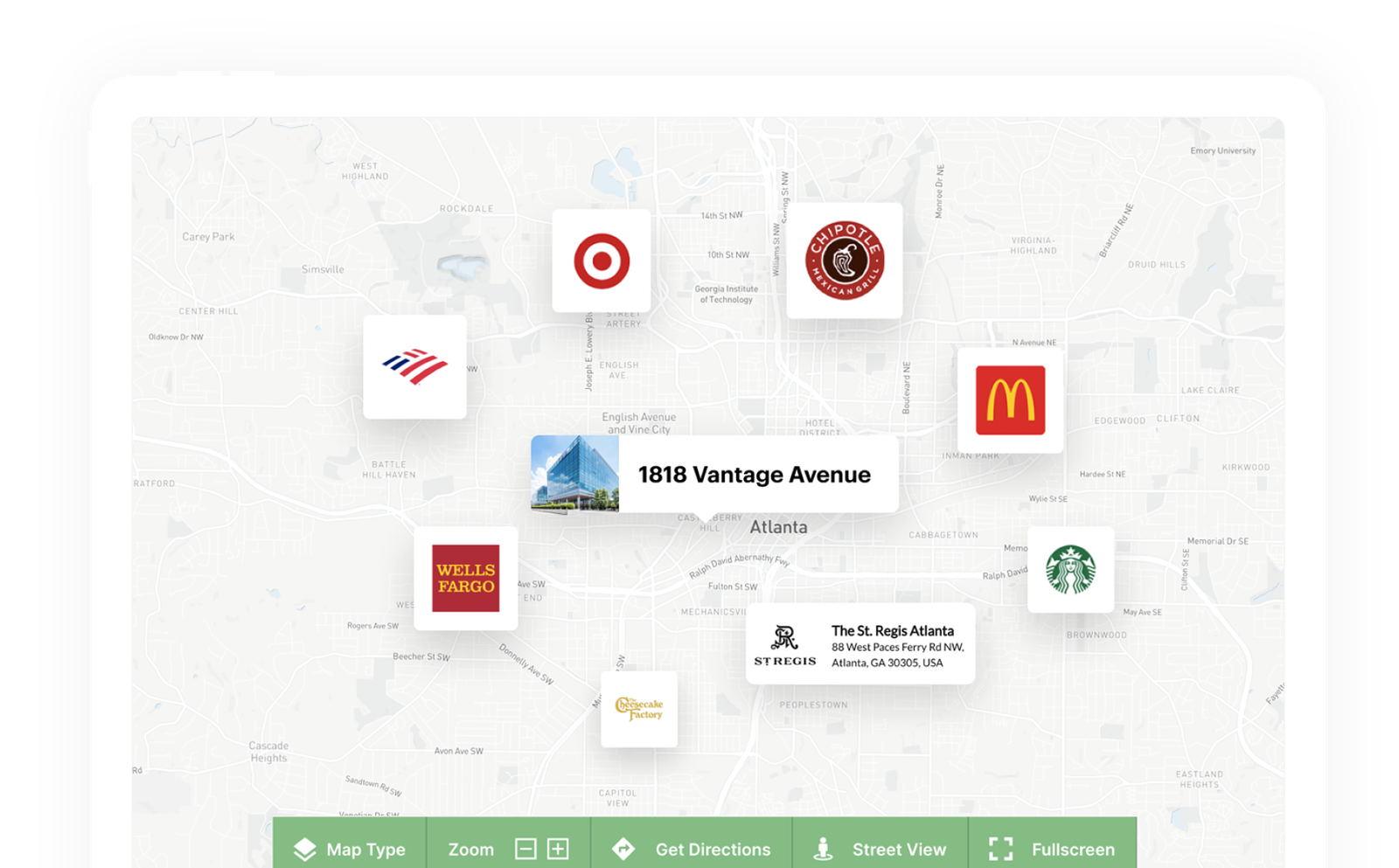
Consider incorporating a custom illustrated map into your offering memorandum to enhance its visual appeal and convey professionalism. By opting for a custom design, you can ensure that the map seamlessly integrates with the overall aesthetic of your document, reinforcing your brand identity.
Additionally, overlaying labels or call-outs on the map allows you to spotlight key features such as nearby amenities, transportation hubs, and corporate neighbors. This contextual information provides valuable insights for potential stakeholders, helping them better understand the surrounding environment and the strategic positioning of the property.
A well-crafted illustrated map not only enhances the presentation of your offering memorandum but also adds depth and clarity to your property’s value proposition.
7. Optimize PDF file size
In today’s fast-paced digital CRE world, optimizing file size of your offering memorandum is essential to reduce friction for your buyers. By optimizing settings, you can facilitate fast download speeds, delivering a seamless user experience for investors accessing the document online.
Prioritizing file size optimization not only minimizes barriers for your buyers but also fosters positive impressions and engagement for your investment opportunity.
Here are some tips to remember:
- Compress the PDF file to reduce its size for faster downloading and sharing
- Aim for the file size of your OM to be between 2MB to 10MB
- Test the PDF on various devices and platforms to ensure compatibility
8. Build Your Digital Offering and Deal Room
Modern investment sales are won and lost in the digital experience. Buyers expect more than a PDF attachment in a cold email. A purpose-built deal room lets you:
- Control document access with NDA-gating and user-level permissions
- Track who viewed the OM, which pages they spent time on, and when they returned
- Deliver a single, always-current link instead of multiple PDF versions
- Add video tours, drone footage, and interactive maps without file size constraints
- Receive and manage inquiries from a single platform
5 Common Offering Memorandum Mistakes to Avoid

1. Inconsistent or Unverified Financial Data
The most common and most damaging mistake is presenting financial data that does not reconcile with the rent roll or operating statements. Buyers model everything. Discrepancies discovered in due diligence create doubt about everything else in the document and almost always result in a retrade. Reconcile your numbers to actuals before the OM is published, not after.
2. Generic Market Commentary
Boilerplate descriptions of a city’s economy copied from a third-party report do not make the case for this property in this submarket. Use specific, current, local data — submarket vacancy, asking rent trends, recent comparable sales — tied to the investment thesis you are making.
3. Weak or Missing Photography
Investment real estate buyers are human. They respond to great images. An OM with four blurry exterior photos and no interior images signals that either the property has something to hide or the broker does not take the assignment seriously. Both kill deals.
4. No Clear Call to Action
Buyers should never have to wonder what to do next. Every OM needs an explicit call to action: how to submit a letter of intent, who to contact with questions, how to access the data room, and when offers are due. Ambiguity extends timelines and gives buyers an excuse not to engage.
5. Distributing Before the Document Is Complete
Sending a draft OM to buyers before it is complete undermines confidence in the deal and your firm. Once a buyer forms a negative impression of an opportunity, it is nearly impossible to reverse. Distribute only when the document is fully reviewed and all data is verified.
The Bottom Line
An offering memorandum is not a formality. For investment sales brokers, it is the primary tool for establishing credibility, attracting competitive bids, and compressing the deal timeline. The brokers who produce the best OMs — accurate data, clear narrative, professional design, intuitive deal room — consistently win more listings, field stronger offers, and close faster.
Use this guide as a checklist for your next deal. And if you want to cut production time while improving quality, see how SharpLaunch can help.
What is SharpLaunch?
SharpLaunch is an all-in-one CRE marketing platform to help you streamline your marketing efforts and modernize your digital presence.
FAQ
How long should an offering memorandum be?
Most OMs for commercial properties run 20 to 40 pages. Length should be dictated by what buyers need to make an informed decision, not by a desire to appear thorough. Every page that does not add information removes reader attention from pages that do.
Should I include financing assumptions in the OM?
Yes, illustrative financing assumptions help buyers quickly assess returns. Clearly label them as illustrative and note the assumed loan-to-value, interest rate, and amortization period. Buyers will run their own leverage scenarios, but your model sets the frame and speeds up their analysis.
Do I need to hire a graphic designer to create an OM?
Not if you use a purpose-built CRE marketing platform. Traditional OM production required either an in-house designer or an outsourced agency, both are expensive and slow. Platforms like SharpLaunch include branded OM builders that let brokers produce professionally designed documents without design skills or external vendors.
How often should I update the OM during a listing campaign?
Update the OM any time material information changes: a new lease is executed, a major tenant gives notice, capital improvements are completed, or the asking price is adjusted. Version-control your document so buyers always have access to the most current data. Using a digital deal room makes this easier because you update one document in one place rather than re-sending PDFs to every prospect.
Related Blog Posts
Marketing Best Practices
13 Property Description Tips to Attract More Buyers & Tenants
Commercial real estate marketing requires thoughtful investment across multiple channels, but...
Marketing Best Practices
Commercial Property Management Software: The Ultimate Guide
A good commercial property management software platform goes above and beyond work orders and...
Marketing Best Practices
Why Your CRE Marketing Looks Outdated (And How It’s Quietly Hurting Your Deals)
Commercial real estate teams are working harder than ever to win attention, build trust and...